
BOTH SIDES OF THE PAPER, by David Brider #PGat35
 IMPORTANT: This review contains SPOILERS. Massive great honking ones. If you haven’t ever seen Press Gang (Seriously?! Are you a KD?!!! What are you even doing here reading this, you fool?! Click right on over to Amazon, buy yourself the complete series boxset and remedy that situation immediately before you read any further…) #CommissionsEarned
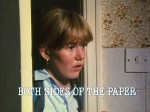
Sarah’s nightmares and Lynda’s ambitions collide.

Revisiting early Press Gang can be a disconcerting experience. It’s not that it’s bad – good lord, no. I love it, you do too or you most likely wouldn’t be reading this, it’s the show that launched Steven Moffat’s career on a stellar trajectory (we just won’t mention Chalk, okay?) and also inspired Jason Haigh-Ellery to launch his company, Big Finish, now renowned the world over for producing top quality audio dramas, mainly based on Doctor Who, (they even managed to get Mr Moffat to pen a short story in one of their occasional printed collections). Oh, if you’re not clear in what way Mr Haigh-Ellery was inspired, you may want to skip to the end of series 2, which is a good bit and has Kenny Phillips being the Yummiest Man in RockTM in it…
 No, it’s not bad. But it can be a bit mixed, a trifle inconsistent at times. The first episode, Page One, is already a vast improvement on that business in the original pitch brief with the Newks and the Setz (which almost reads as if Moffat, less than a decade on from being a teenager himself, had forgotten what being a teenager was like. Either that, or he grew up in a particularly clichéd bit of Paisley), but then in One Easy Lesson we get the appallingly hamfisted attempt to shoehorn a Monty Python joke into the script. Fortunately, that turns out to be just a misfire, things progress nicely, we have beautiful little episodes like Deadline and Interface and the first self-consciously issue based two-parter in How to Make a Killing (which works so well they revisit the approach twice in subsequent seasons), and we’re on course for a blast of a season-closer in Monday-Tuesday and Shouldn’t I be Taller?, and then, before we get there…
…oh yes, here comes Both Sides of the Paper.
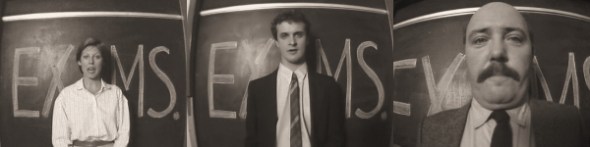
I forget when it was that I noticed that the title of this episode is a bit of a pun. Because in the exam situation, the students are told to (as per the teachers at the beginning of the episode) “write on both sides of the paper,” but also, we see both sides of the newspaper team: those who need to concentrate on their exams, pitted against those who want to keep the newspaper operational (and eventually realising that things work best if both sides of the paper work together). It’s rather a clever pun. So clever, it took me a while to get it…
It’s all very well having a clever pun for a title, but…what of the episode itself? I’ll be honest – I’m a bit of a Kenny Phillips. I like everybody, and, when it comes to Press Gang, every episode. Yes, even She’s Got It Taped. But I’ve got to admit, I find it difficult to muster up any real love for Both Sides of the Paper. In its defence, it’s brief. It takes one, 25-minute episode to tell a story that Grange Hill would have probably dragged out over half a season. And it’s got Colin providing both the comic relief (as usual, although strangely muted in this episode… actually, maybe that’s not so strange at all, for reasons we’ll come to) and having a rare ‘Colin saves the day’ moment.
It’s quite a Sarah-intensive episode, and is the first of a trilogy of Sarah/Lynda conflict episodes, that would be followed up by Love and the Junior Gazette and Friends Like These, which is no bad thing (I will express a personal bias here: I like Kelda Holmes.)
 The problem is, that Sarah-intensiveness is put into an episode which attempts to drive home its moral with the subtlety of a sledgehammer. Yes, exams are a time of pressure. Yes, it’s good for all the students to work together. But Press Gang‘s main strength was that, in its first two seasons, despite the main characters still being of school age (and indeed actually in full-time education), the programme managed to avoid going down the predictable route of being essentially a school-based, Grange Hill clone. This episode, though, is about as school-centric as they come, and that bores me quite a lot.
 But, like I said, this season is mixed. And this is one of the most mixed episodes there is. In amongst the rather boring backdrop are some wonderful moments. Many of the wonderful moments involve Sarah’s exam anxiety (“I’ve been counting sheep ’til I see the same ones come round again…”). Waking up thinking it’s time for the exam when it’s actually some ungodly hour in the morning is probably familiar to most of us. Dreaming of going to school in pyjamas is commonplace. Dreaming of turning over the exam paper and finding it’s written in Chinese comes from somewhere way out of left field. What that scene says about Moffat’s subconscious, I wouldn’t like to speculate. I can only suppose that, had the episode been even longer the anxiety dreams would have become even more surreal, with Sarah finding that the exam room had been relocated to eighteenth-century France, could only be accessed by magic time windows, and had been overrun by clockwork robots…

Other wonderful moments include and Lynda and Spike having rather a nice platonic relationship for an episode (an interesting glimpse into what could have been, perhaps?), and Kenny being reliable as ever, even though Lynda doesn’t necessarily appreciate him, and David Collings and Clive Wood leaving you wondering why they never got BAFTAs (in their careers, never mind for Press Gang).
 But most of this episode’s best moments are Patrick Barlow stealing the show. When first introduced as ‘Tony Nolan, Phone Ranger’, you want to hit him. Or scream at him. Or at least tell him he’s a bit of a numpty. He seems inept, confused, not particularly good at the job he has to do (which isn’t a terribly difficult one), and possibly lacking in grey matter (“…the guy’s certified brain dead!”). In short, he’s a wonderfully written and acted character. And then, to top it all, we’re treated to that moment where he has a quiet word with Lynda. At which point we realise that the Phone Ranger is a front, a sham, and the real Tony Nolan is a far kinder, more intelligent, and dammit sympathetic person then we’ve been led to believe so far, and Barlow switches from pathetic loser to archly camp in an instant.
 It’s such a pity, really, that the whole plot development of him offering Lynda a job is written off with a never-explained line from Matt Kerr, and Nolan/Barlow is never seen again in Press Gang. He’d have made a wonderful permanent addition to the regular cast. What a missed opportunity.

Classic Lynda indignation. Spike has the decency to look embarrassed enough for both of them…

Editor’s footnote: Our friend David Brider sadly passed away in early 2020. He was passionate about Press Gang, as I am sure you can tell from this review, which was originally posted as part of #PG@25 in 2014. To find more about David, you can visit his memorialised Facebook account.




 Press Gang @ 35